Whether you are asking prices while traveling in Japan, saying your phone number, or checking the time on a train, numbers are one of the most practical Japanese basics you need to recall instantly. Counting from 1 to 10 in Japanese is similar to Chinese, so it is not difficult for Chinese speakers. Because the Japanese number system works like Chinese, once you know 1 to 10, numbers from 11 to 99 become easy. For example, 1 is ichi and 10 is jyuu, so 11 is jyuu ichi. 2 is ni, so 22 is ni jyuu ni, and so on. But many beginners hit the same snag: why do 四 (shi / yon), 七 (shichi / nana), and 九 (ku / kyuu) each have two completely different readings? Todaimae has prepared pronunciation charts with audio, cultural explanations, and interactive GeGe games to clear up every number-reading myth in one go!
This is a question every Japanese beginner asks! It has to do with on’yomi (readings from ancient Chinese) and kun’yomi (native Japanese readings), as well as cultural taboos:
Regarding taboo culture, the on’yomi of 四, 「し (shi)」, sounds the same as 死 (shi, “death”). The on’yomi of 九, 「く (ku)」, sounds the same as 苦 (ku, “suffering”). So in daily life (for example when reading phone numbers or counting people), Japanese people often avoid the unlucky readings and use 「よん (yon)」 and 「きゅう (kyuu)」 instead.
Also, the on’yomi of 七, 「しち (shichi)」, sounds too similar to 一 (ichi) and 八 (hachi), which can cause mix-ups. For clearer communication, modern Japanese speakers strongly prefer 「なな (nana)」.
Asking the price:
A: これはいくらですか? (How much is this?)
B: 九百円です。(It's 900 yen.)
Saying a phone number (in Japanese, phone numbers are read digit by digit):
私の電話番号は 3176-7108 です (My phone number is 3176-7108)
| Kanji | Hiragana | Romaji | Hiragana | Romaji | English | Audio |
|---|---|---|---|---|---|---|
| ゼロ / 零 | ぜろ / れい | zero/ree | - | - | zero | |
| 一 | いち | ichi | ひとつ | hitotsu | one | |
| 二 | に | ni | ふたつ | hutatsu | two | |
| 三 | さん | san | みっつ | mittu | three | |
| 四 | よん / し | yon / shi | よっつ | yottu | four | |
| 五 | ご | go | いつつ | itsutsu | five | |
| 六 | ろく | roku | むっつ | muttsu | six | |
| 七 | なな / しち | nana / shichi | ななつ | nanatsu | seven | |
| 八 | はち | hachi | やっつ | yattsu | eight | |
| 九 | きゅう / く | kyuu / ku | ここのつ | kokonotsu | nine | |
| 十 | じゅう | jyuu | とお | too | ten |
| Kanji | Hiragana | Romaji | English | Audio |
|---|---|---|---|---|
| 十 | じゅう | jyuu | ten | |
| 二十 | にじゅう | nijyuu | twenty | |
| 三十 | さんじゅう | sanjyuu | thirty | |
| 四十 | よんじゅう | yonjyuu | forty | |
| 五十 | ごじゅう | gojyuu | fifty | |
| 六十 | ろくじゅう | rokujyuu | sixty | |
| 七十 | ななじゅう | nanajyuu | seventy | |
| 八十 | ハちじゅう | hachijyuu | eighty | |
| 九十 | きゅうじゅう | kyuujyuu | ninety |
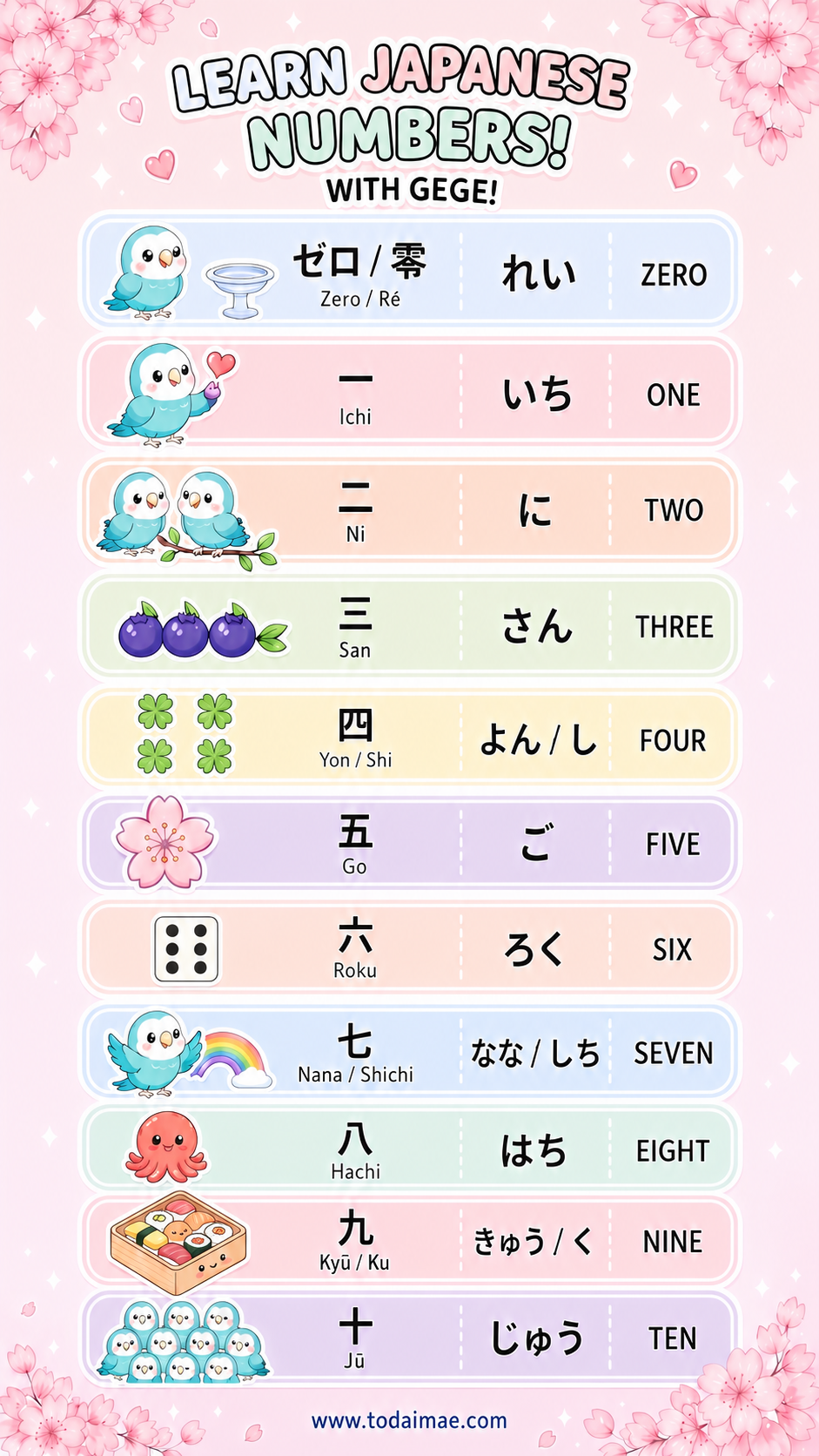
Visual memory is the fastest way to learn numbers! Download Todaimae’s exclusive free “GeGe Numbers Wallpaper” now. An octopus for 8, a rainbow for 7—you’ll remember them at a glance!


Todaimae offers Japanese courses from JLPT N5 to N1, covering beginner through advanced levels. Experienced instructors teach in an interactive environment to strengthen reading, writing, listening, and speaking. Choose in-person classes or live online lessons to fit your schedule—whether you are preparing for the JLPT, advancing your career, or getting ready for life in Japan.