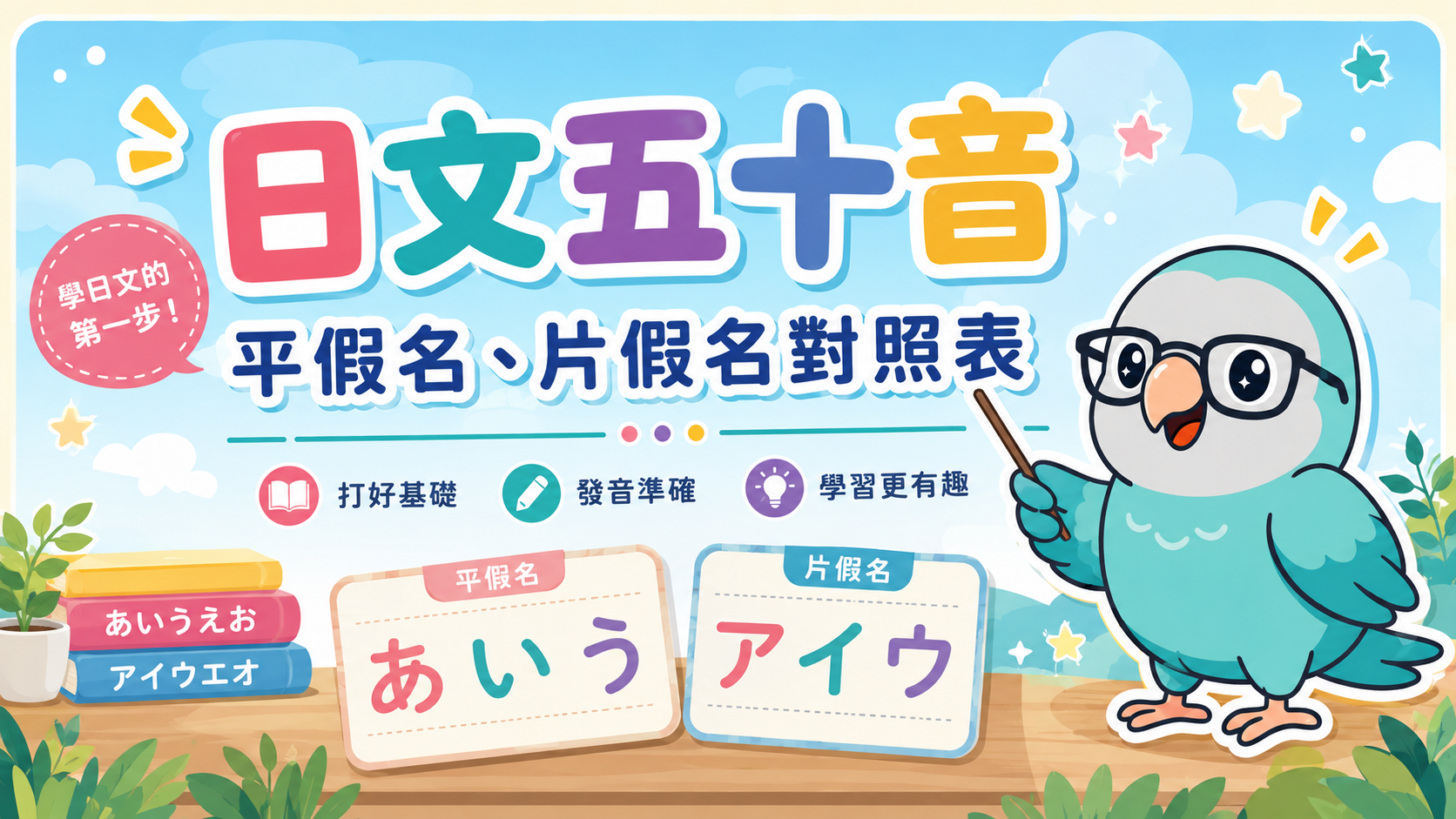
What's the difference between hiragana and katakana? When do you use each? Todaimae Japanese Language School prepared this all-in-one Hiragana–Katakana Comparison Chart for beginners. Rounded hiragana on the left, sharp katakana on the right. Every character is recorded by our native Japanese teachers—tap to listen instantly! Whether you're a parent looking for kids' Japanese classes or an adult ready to study further, this chart is the perfect starting tool.
Many self-learners feel overwhelmed by these two writing systems when they first start learning Japanese. Todaimae has summarized three must-know points to clear things up quickly:
1. Why is it called "gojuon" (fifty sounds) when there are only 46 characters?
This is a classic frequently asked question! In ancient times, the Japanese gojuon chart (5 columns × 10 rows) really did fill 50 slots. Over time, some readings became identical (for example, overlapping sounds in certain 「い」 and 「え」 rows), and modern Japanese simplified by dropping rarely used characters (such as 「ゐ」 and 「ゑ」). What remains is 45 basic sounds plus the independent 「ん」—the 46 kana we use today.
2. Visual style: Rounded cursive forms vs. angular character components
Hiragana: Softer, more curved shapes. Evolved from the full cursive form of Chinese characters (e.g. 「あ」 comes from 「安」). In modern Japanese, it is used most for everyday writing, particles, and native Japanese words.
Katakana: More angular, squared, with straight strokes. Ancient monks simplified kanji by taking radicals or partial strokes for quick notes (e.g. 「イ」 comes from the person radical of 「伊」). Today it is mainly used for loanwords (internet, hamburger), foreign names, and emphasis.
3. Kana that even native Japanese speakers do a double take on
Have you noticed? Hiragana 「へ」 and katakana 「ヘ」 look almost identical—same origin (both from 「部」) and nearly the same writing. The tiny difference is that katakana 「ヘ」 has sharper angles. Some katakana rarely appear alone (such as the particle 「ヲ」). Tap and listen repeatedly on our interactive audio chart with lively illustrations, and you'll tell them apart with ease!
Love the online comparison chart and want a physical copy you can flip through anytime?
Todaimae turned the cute web design into a high-quality physical double-sided A4 gojuon folder! Both sides print the hiragana–katakana comparison—the perfect Japanese study companion for your desk or your child's.
It's easy to get one: just WhatsApp us and say "I'd like a free Todaimae double-sided A4 gojuon folder," then pick it up at our Tseung Kwan O or Ma On Shan campus. Limited quantity—while stocks last!


Todaimae offers Japanese courses from JLPT N5 to N1, covering beginner through advanced levels. Experienced instructors teach in an interactive environment to strengthen reading, writing, listening, and speaking. Choose in-person classes or live online lessons to fit your schedule—whether you are preparing for the JLPT, advancing your career, or getting ready for life in Japan.