How do you say Mid-Autumn Festival and mooncake in Japanese? Learn words for full moon, pomelo, dango, lanterns, moon viewing, harvest, and susuki grass.

When Mid-Autumn Festival arrives, everyone receives mooncakes of all sizes from relatives and friends. But have you ever wondered how Japanese people mark the occasion? Is there a Mid-Autumn holiday in Japan? Do people eat mooncakes, or local traditional snacks instead? Let's answer these questions one by one.
Japan also has Mid-Autumn customs, said to have come from ancient China, but the way people celebrate is quite different. In Hong Kong, Mid-Autumn Festival is about family reunion—visiting relatives and friends, playing with lanterns in the park, and moon viewing. In Japan, there is no custom of gathering with family for the festival, nor of going around with lanterns.
In Japan, Mid-Autumn is not a major holiday. It is best known simply as "the biggest, brightest full moon of the year," so there is no public Mid-Autumn holiday—though plenty of people still go out to view the moon.
The Mid-Autumn Festival in Japanese is 「中秋の名月」(ちゅうしゅうのめいげつ), also called 「十五夜」(じゅうごや). 「十五夜」 refers to the night of the 15th day of the 8th lunar month—in other words, the day the moon is fullest and brightest. Because modern Japan uses the Gregorian calendar and not the lunar calendar, most Japanese people treat the full-moon day between September 7 and October 8 each year as 「十五夜」.
Mention 「中秋の名月」, and many Japanese people think of the children's song 『十五夜お月さん』, with lyrics by Noguchi Ujo (野口雨情 のぐちうじょう), a well-known poet of the Meiji and Taisho eras.
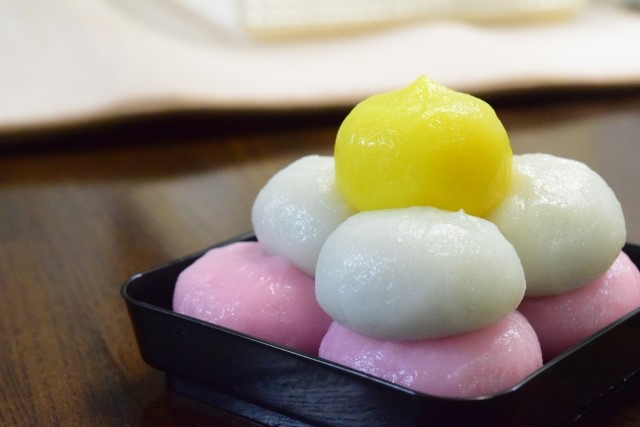
In Japan, Mid-Autumn also celebrates the harvest. Autumn is associated with gathering crops, so people traditionally offer dango to the gods in thanks. After the offering, the dango are eaten or shared with neighbors and children—that is 「月見団子」(つきみだんご). There is even a folk saying about 「お月見泥棒」 ("moon-viewing thieves"): on 「十五夜」, even if the dango offered to the gods are stolen, people let it go because the harvest has been so abundant.
In Japanese mythology, many animals appear in the age of the gods, and the rabbit is a messenger of the gods. The Chinese legend of Chang'e flying to the moon never took hold in Japan; instead, the crater patterns on the moon's surface are said to look like a rabbit pounding mochi with a pestle. That may partly be because "pounding mochi" (もちつき mochitsuki) and "full moon" (もちづき mochizuki) sound alike. Autumn is also rice-harvest season. Since ancient times, Japanese people have held festivals praying for a good rice crop, and the emperor still performs harvest rites each year. In early September, when rice is harvested, tsukimi dango are offered to the gods in thanks for a plentiful crop.
Because tsukimi dango are offerings to the gods, the rice cakes are simply shaped into round dumplings, stacked in a pyramid on a small offering stand, and placed on a porch where the moon can be seen. White, round tsukimi dango are a Kanto custom.
As for the familiar Mid-Autumn mooncakes, they are not very popular in Japan. Mooncake in Japanese is also 「月餅」(げっぺい), but there is no custom of eating mooncakes for the festival. Of course, if you give mooncakes to Japanese friends at Mid-Autumn, they will gladly accept them.

As a side note, Hong Kong businesses are not alone in capitalizing on Mid-Autumn—Japanese companies do just as well. Famous fast-food chains roll out a "Tsukimi Burger" menu every September, and it is hugely popular. 「お月見」(おつきみ) means moon viewing in Japanese, so these are essentially "moon-viewing burgers."
Although there is no custom of exchanging mooncakes, you can buy small mooncake-like sweets filled with red-bean paste, white-bean paste, or other nuts at traditional Japanese confectionery shops that sell dorayaki (どら焼き どらやき). In Japan, they are given as gifts year-round.
| Kanji | Hiragana | Romaji | Chinese | English | Audio |
|---|---|---|---|---|---|
| 中秋の名月 | ちゅうしゅうのめいげつ | chūshū no meigetsu | 中秋節 | Mid-autumn | |
| 満月 | まんげつ | mangetsu | 滿月 | Full moon | |
| 十五夜 | じゅうごや | jūgoya | 圓月 | Fifteen night | |
| 月餅 | げっぺい | geppei | 月餅 | Moon cake | |
| お月見 | おつきみ | otsukimi | 賞月 | Moonlight viewing | |
| 団子 | だんご | dango | 團子 | Japanese dumpling | |
| 文旦 | ぶんたん | buntan | 碌柚 | Pomelo | |
| 秋 | あき | aki | 秋天 | Autumn | |
| 豊作 | ほうさく | hōsaku | 豐收 | Good harvest | |
| 兎 | うさぎ | usagi | 兔子 | Rabbit | |
| 芒 | すすき | susuki | 細葉芒 | Miscanthus sinensis | |
| 提灯 | ちょうちん | chōchin | 燈籠 | Lantern |


Todaimae offers Japanese courses from JLPT N5 to N1, covering beginner through advanced levels. Experienced instructors teach in an interactive environment to strengthen reading, writing, listening, and speaking. Choose in-person classes or live online lessons to fit your schedule—whether you are preparing for the JLPT, advancing your career, or getting ready for life in Japan.