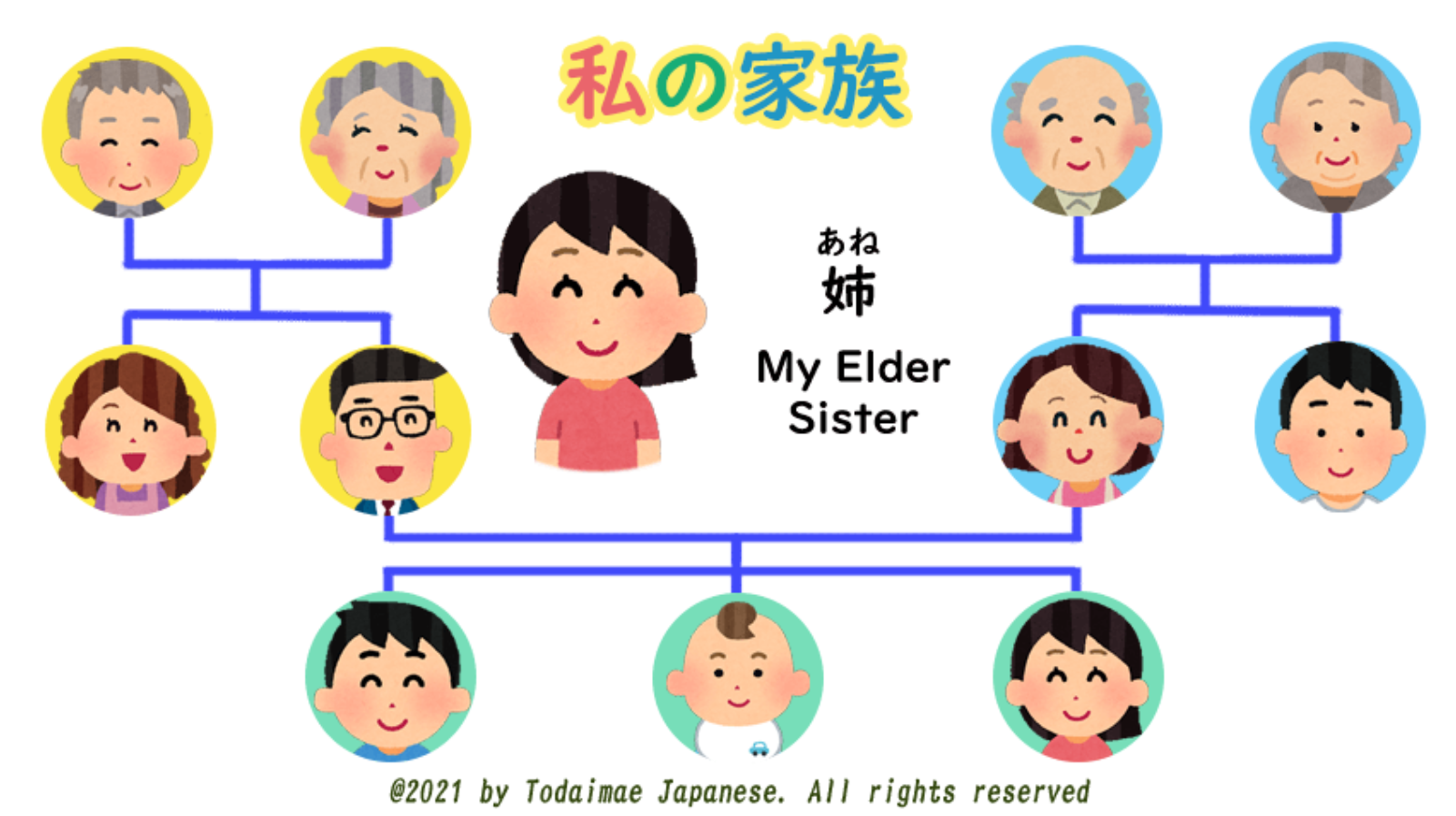
This lesson covers Japanese family-member vocabulary and pronunciation, and explains the difference between honorific and humble forms for family titles.
Tap the images to hear the Japanese pronunciation
1) When speaking directly to your own family, use honorific forms for elders—e.g. call your mother 「おかあさん」 and your father 「おとうさん」. For relatives younger than you, you can call them by name, such as younger siblings.
2) In front of outsiders, when referring to the other person’s family (or someone else’s family), you also use honorific forms. For “your father,” you don’t need 「あなたのおとうさん」—just 「おとうさん」 can mean the other person’s (or someone’s) father. For the other person’s younger siblings, even though they are younger than you, you still use the honorific 「おとうとさん」 and 「いもうとさん」.
Tap the images to hear the Japanese pronunciation
3) In front of outsiders, when referring to your own family, use humble forms—e.g. 「ちち」 for your father, 「はは」 for your mother, and 「いもうと」 for your younger sister.
| Kanji | Hiragana | Romaji | Chinese | English | Audio |
|---|---|---|---|---|---|
| 家族 | かぞく | kazoku | 家庭 | family | |
| お父さん | おとうさん | otousan | 爸爸 | father | |
| お母さん | おかあさん | okaasan | 媽媽 | mother | |
| お兄さん | おにいさん | oniisan | 哥哥 | elder brother | |
| お姉さん | おねえさん | oneesan | 姐姐 | elder sister | |
| *弟さん | おとうとさん | otoutosan | 弟弟 | younger brother | |
| *妹さん | いもうとさん | imoutosan | 妹妹 | younger sister | |
| お爺さん | おじいさん | ojiisan | 爺爺/公公 | grandfather | |
| お婆さん | おばあさん | obaasan | 嫲嫲/婆婆 | grandmother |
* When speaking directly to younger relatives such as younger siblings, you usually just call them by name.
| Kanji | Hiragana | Romaji | Chinese | English | Audio |
|---|---|---|---|---|---|
| 家族 | かぞく | kazoku | 家庭 | family | |
| 私 | わたし | watashi | 我 | me | |
| 父 | ちち | chichi | (自己)父親 | (my) father | |
| 母 | はは | haha | (自己)母親 | (my) mother | |
| 兄 | あに | ani | (自己)哥哥 | (my) elder brother | |
| 姉 | あね | ane | (自己)姐姐 | (my) elder sister | |
| 弟 | おとうと | otouto | (自己)弟弟 | (my) younger brother | |
| 妹 | いもうと | imouto | (自己)妹妹 | (my) younger sister | |
| 祖父 | そふ | sofu | (自己)祖父/外祖父 | (my) grandfather | |
| 祖母 | そぼ | sobo | (自己)祖母/外祖母 | (my) grandmother |


Todaimae offers Japanese courses from JLPT N5 to N1, covering beginner through advanced levels. Experienced instructors teach in an interactive environment to strengthen reading, writing, listening, and speaking. Choose in-person classes or live online lessons to fit your schedule—whether you are preparing for the JLPT, advancing your career, or getting ready for life in Japan.